
Seesnote #705 – Communication
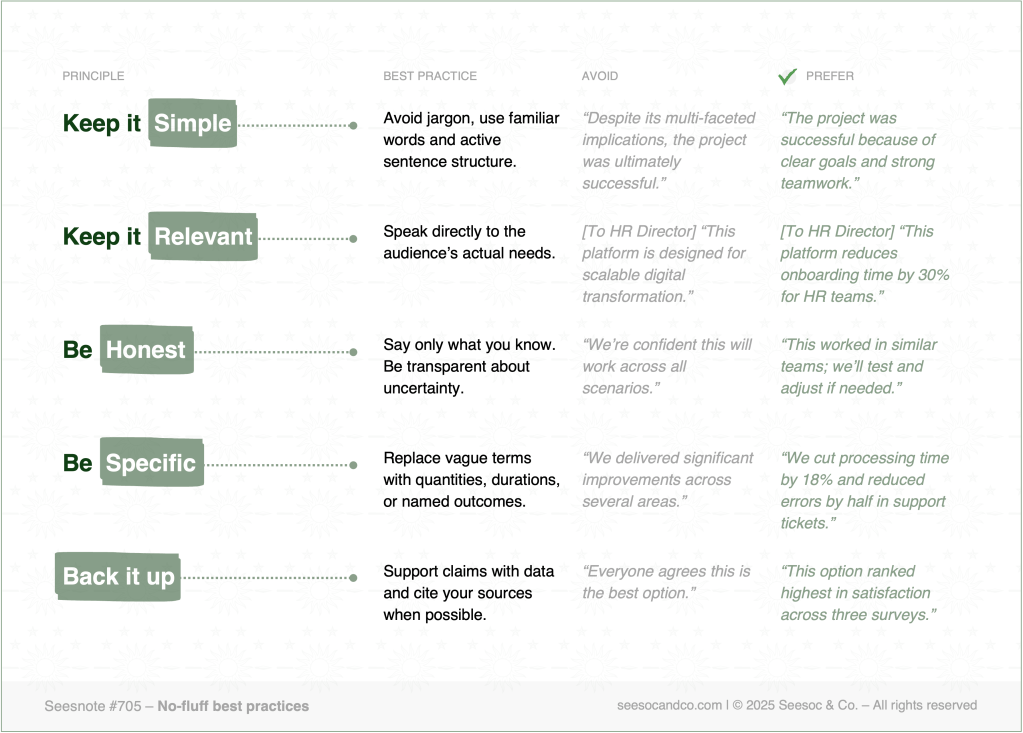
Why is it important?
Some professionals rely on vague or inflated language, which quickly undermines credibility with experienced audiences and signals a lack of substance.
Big words don’t impress smart audiences. They often come off as faux smart—an attempt to impress that reveals insecurity or underdeveloped communication judgment.
Unlike political speech, where fluff may serve tactical ambiguity, in business it confuses stakeholders and undermines perceived competence.
What to do
Master your topic and anchor your communication in a clear goal. Use direct, specific, concise language, and back up assertions with relevant data or real examples.
When unsure or wrong, be transparent and follow up with verified answers—don’t bluff.
Review AI-generated drafts carefully as AI tools often default to generalities. Use customized or fine‑tuned models to better reflect domain context, tone and improve depth.

Notes
Not all filler is harmful. Strategic ambiguity or enthusiasm has its place in early-stage ideation or morale-building.
For enhanced clarity, consider using the SOWHAT framework to ensure every fact is meaningful, and the VBM Syntax to lead with impact before explaining how it was achieved. These tools sharpen both insight and narrative focus.
Bibliography
- Greene, A. E. (2013). Write science in plain English. University of Chicago Press.
- Minto, B. (2009). The Pyramid Principle: Logic in Writing and Thinking (3rd ed.). Financial Times/Prentice Hall.
- Sissoko, T. (2024). Demonstrate your impact clearly by communicating with the VBM Syntax. Seesoc & Co.
- Sissoko, T. (2024). Elevate your message for impact with the “So What”. Seesoc & Co.
 Seesoc & Co.