
Seesnote #104 – Decision and Problem Solving
Why is it important?
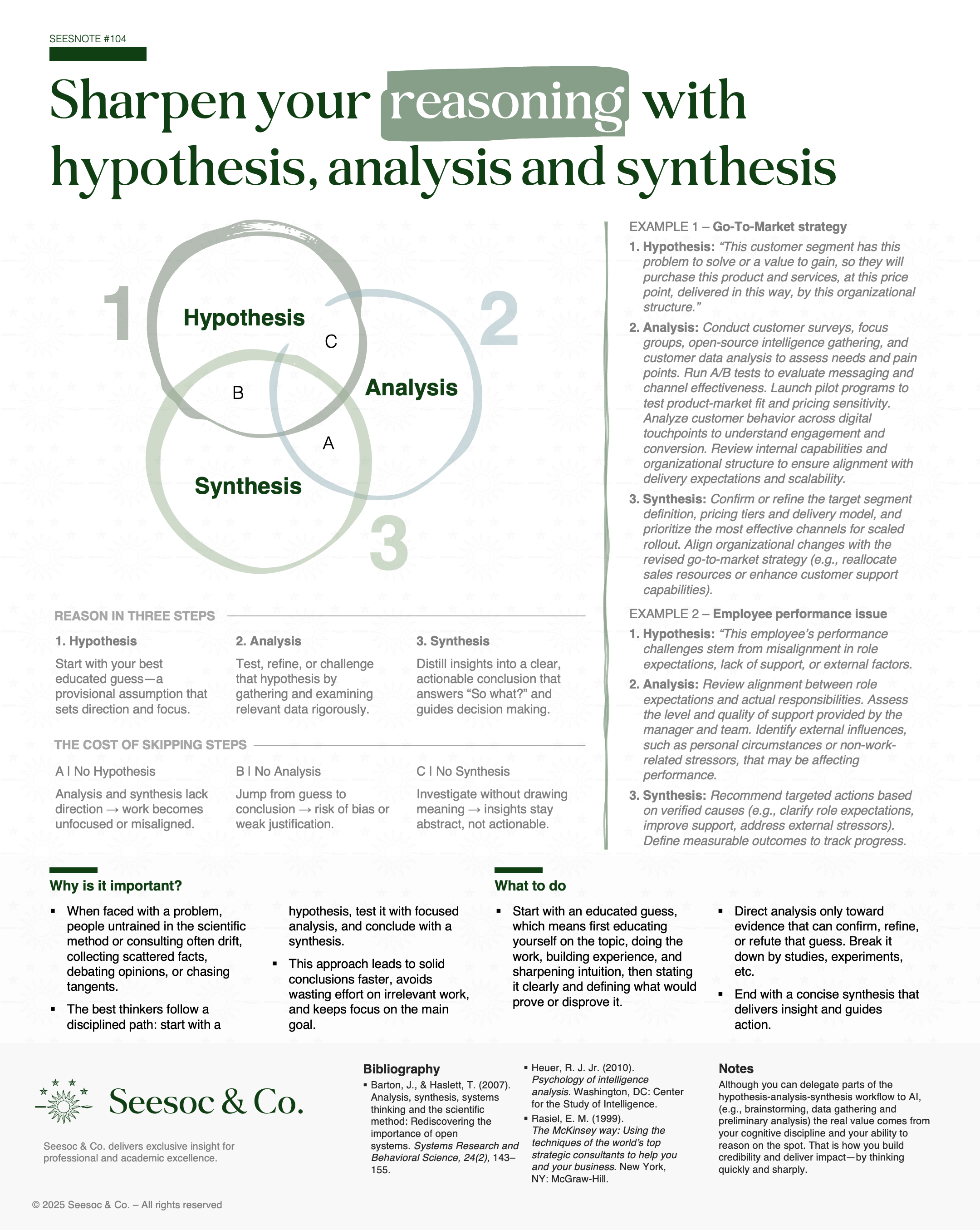
When faced with a problem, people untrained in the scientific method or consulting often drift, collecting scattered facts, debating opinions, or chasing tangents.
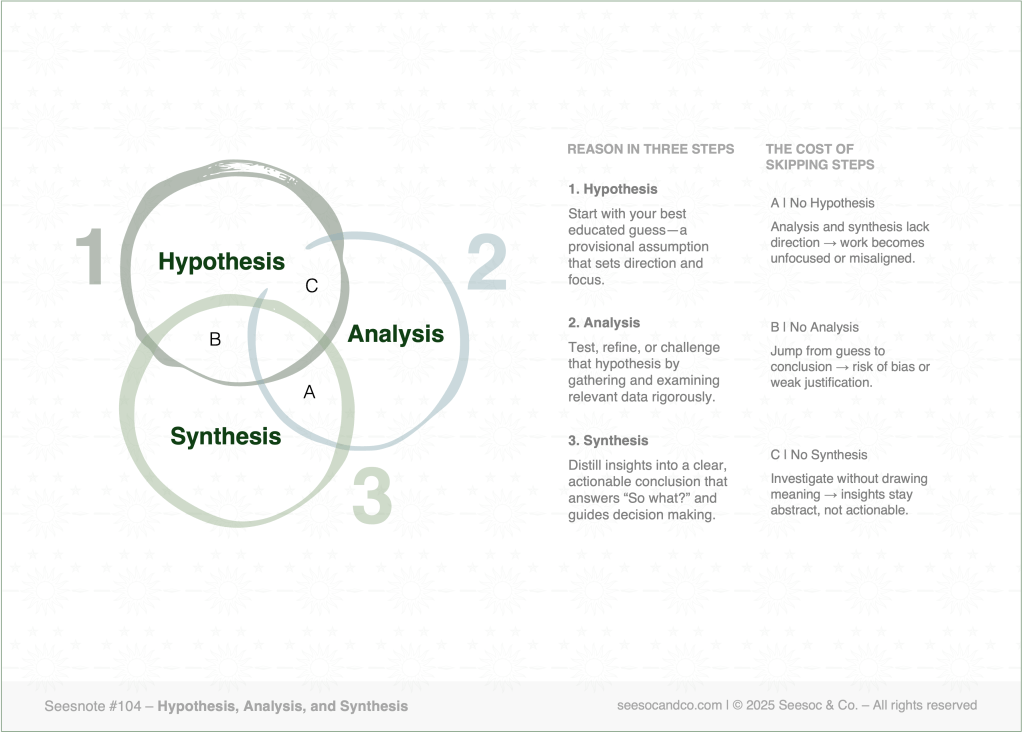
The best thinkers follow a disciplined path: start with a hypothesis, test it with focused analysis, and conclude with a synthesis.
This approach leads to solid conclusions faster, avoids wasting effort on irrelevant work, and keeps focus on the main goal.
What to do
Start with an educated guess, which means first educating yourself on the topic, doing the work, building experience, and sharpening intuition, then stating it clearly and defining what would prove or disprove it.
Direct analysis only toward evidence that can confirm, refine, or refute that guess. Break it down by studies, experiments, etc.
End with a concise synthesis that delivers insight and guides action.
Notes
Although you can delegate parts of the hypothesis-analysis-synthesis workflow to AI, (e.g., brainstorming, data gathering and preliminary analysis) the real value comes from your cognitive discipline and your ability to reason on the spot. That is how you build credibility and deliver impact—by thinking quickly and sharply.
Bibliography
- Barton, J., & Haslett, T. (2007). Analysis, synthesis, systems thinking and the scientific method: Rediscovering the importance of open systems. Systems Research and Behavioral Science, 24(2), 143–155.
- Heuer, R. J. Jr. (2010). Psychology of intelligence analysis. Washington, DC: Center for the Study of Intelligence.
- Rasiel, E. M. (1999). The McKinsey way: Using the techniques of the world’s top strategic consultants to help you and your business. New York, NY: McGraw-Hill.
 Seesoc & Co.