
Seesnote #704 – Communication

Why is it important?
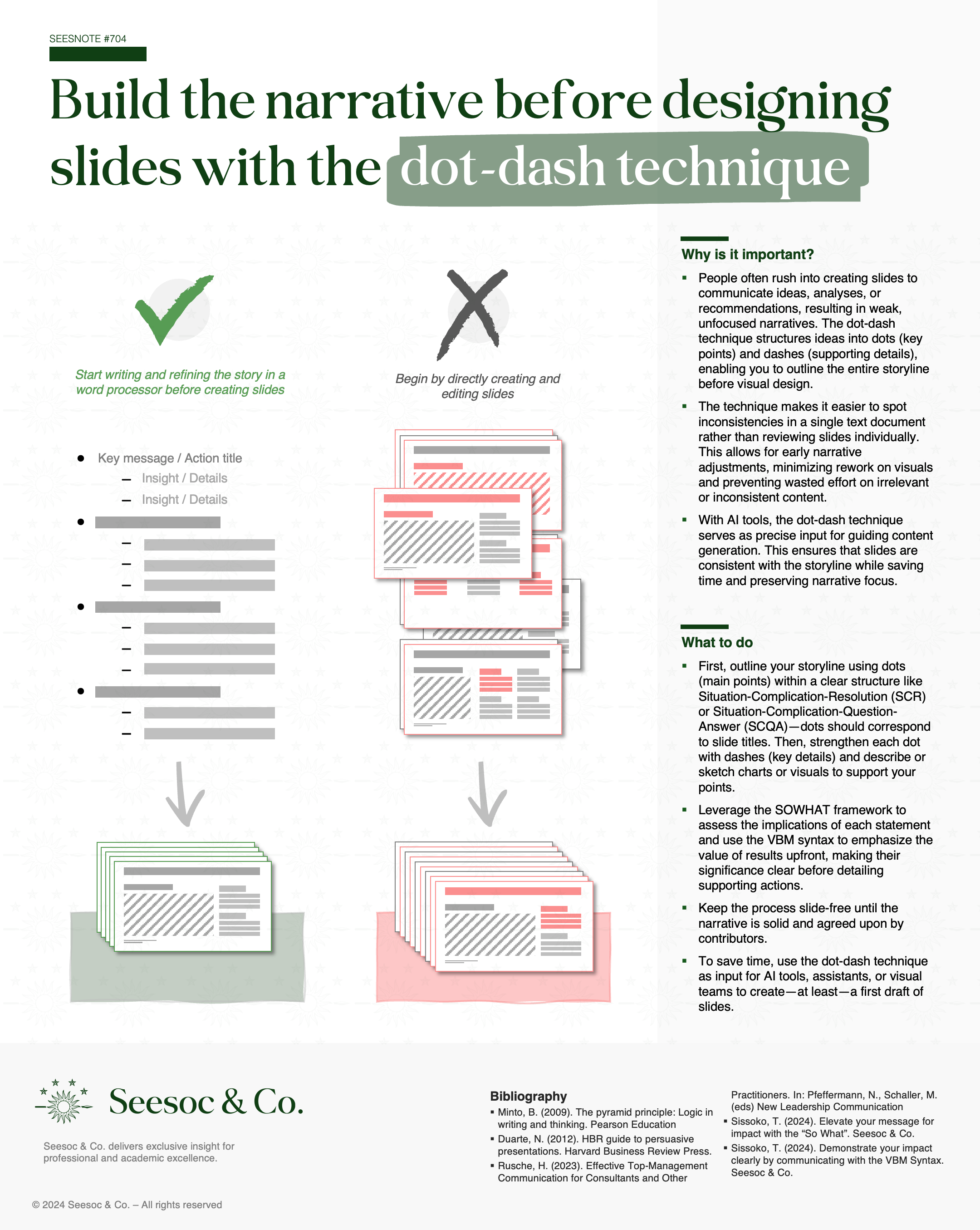
People often rush into creating slides to communicate ideas, analyses, or recommendations, resulting in weak, unfocused narratives. The dot-dash technique structures ideas into dots (key points) and dashes (supporting details), enabling you to outline the entire storyline before visual design.
The technique makes it easier to spot inconsistencies in a single text document rather than reviewing slides individually. This allows for early narrative adjustments, minimizing rework on visuals and preventing wasted effort on irrelevant or inconsistent content.
With AI tools, the dot-dash technique serves as precise input for guiding content generation. This ensures that slides are consistent with the storyline while saving time and preserving narrative focus.
What to do
First, outline your storyline using dots (main points) within a clear structure like Situation-Complication-Resolution (SCR) or Situation-Complication-Question-Answer (SCQA)—dots should correspond to slide titles. Then, strengthen each dot with dashes (key details) and describe or sketch charts or visuals to support your points.
Leverage the SOWHAT framework to assess the implications of each statement and use the VBM syntax to emphasize the value of results upfront, making their significance clear before detailing supporting actions.
Keep the process slide-free until the narrative is solid and agreed upon by contributors.
To save time, use the dot-dash technique as input for AI tools, assistants, or visual teams to create—at least—a first draft of slides.
Bibliography
- Minto, B. (2009). The pyramid principle: Logic in writing and thinking. Pearson Education
- Duarte, N. (2012). HBR guide to persuasive presentations. Harvard Business Review Press.
- Rusche, H. (2023). Effective Top-Management Communication for Consultants and Other Practitioners. In: Pfeffermann, N., Schaller, M. (eds) New Leadership Communication
- Sissoko, T. (2024). Elevate your message for impact with the “So What”. Seesoc & Co.
- Sissoko, T. (2024). Demonstrate your impact clearly by communicating with the VBM Syntax. Seesoc & Co.
 Seesoc & Co.