
Seesnote #702 – Communication | Decision and Problem Solving
Why is it important?
When summarizing information or presenting results, merely stating the facts is often insufficient to drive action.
Decision makers can become frustrated when they do not know what to do with information that required effort to obtain.
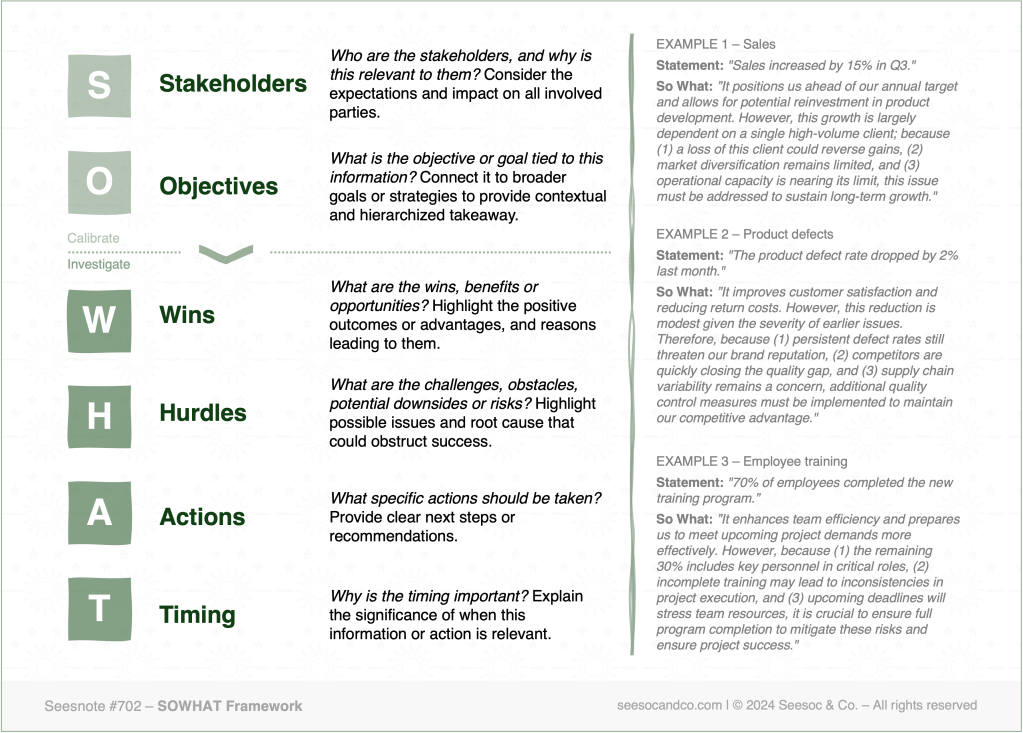
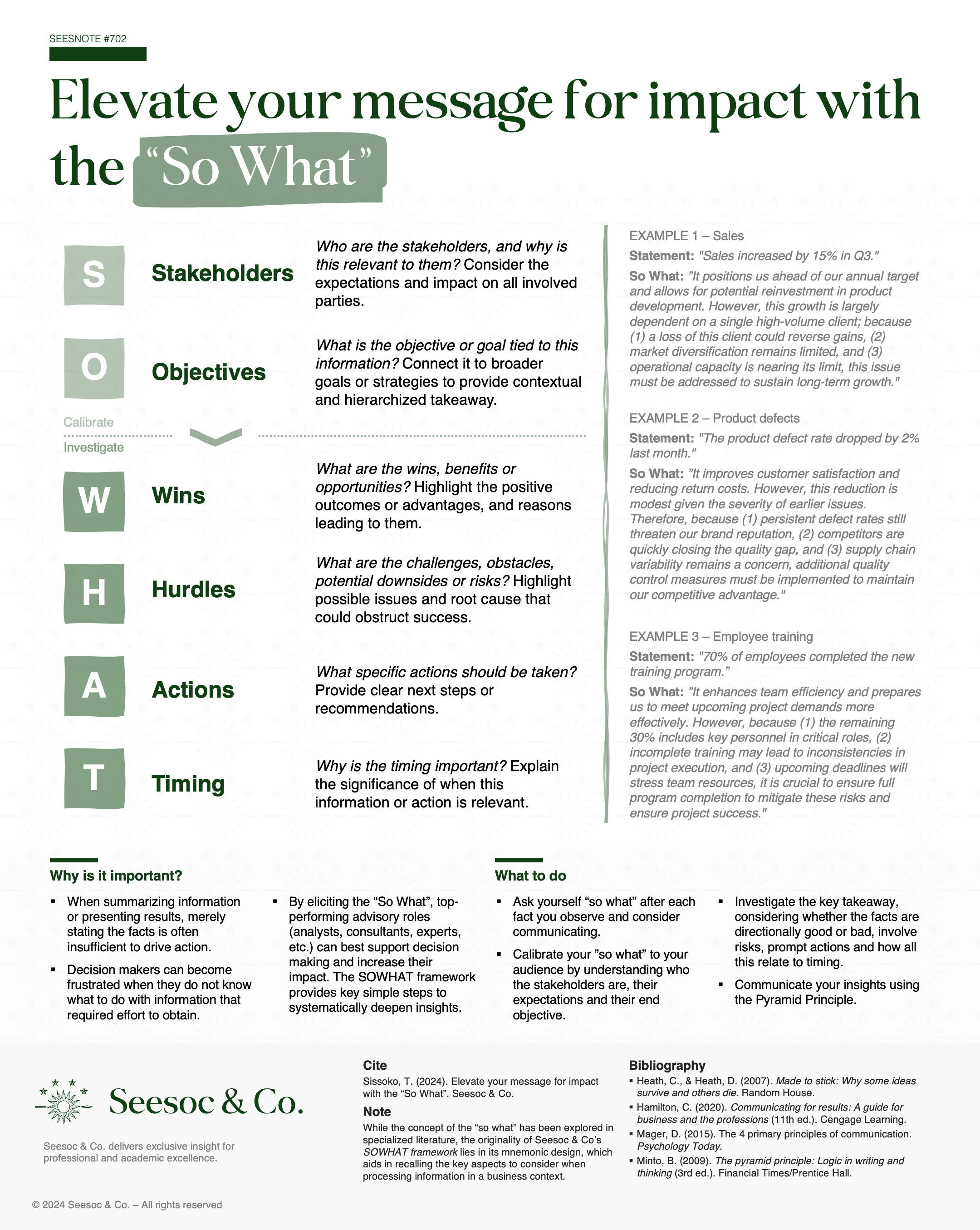
By eliciting the “So What”, top-performing advisory roles (analysts, consultants, experts, etc.) can best support decision making and increase their impact. The SOWHAT framework provides key simple steps to systematically deepen insights.
What to do
Ask yourself “so what” after each fact you observe and consider communicating.
Calibrate your ”so what” to your audience by understanding who the stakeholders are, their expectations and their end objective.
Investigate the key takeaway, considering whether the facts are directionally good or bad, involve risks, prompt actions and how all this relate to timing.
Communicate your insights using the Pyramid Principle.
Listen to the podcast
Download the seesnote
Cite
Sissoko, T. (2024). Elevate your message for impact with the “So What”. Seesoc & Co.
Notes
While the concept of the “so what” has been explored in specialized literature, the originality of Seesoc & Co’s SOWHAT framework lies in its mnemonic design, which aids in recalling the key aspects to consider when processing information in a business context.
Bibliography
- Heath, C., & Heath, D. (2007). Made to stick: Why some ideas survive and others die. Random House.
- Hamilton, C. (2020). Communicating for results: A guide for business and the professions (11th ed.). Cengage Learning.
- Mager, D. (2015). The 4 primary principles of communication. Psychology Today.
- Minto, B. (2009). The pyramid principle: Logic in writing and thinking (3rd ed.). Financial Times/Prentice Hall.
 Seesoc & Co.