
Seesnote #500 – Performance
Why is it important?
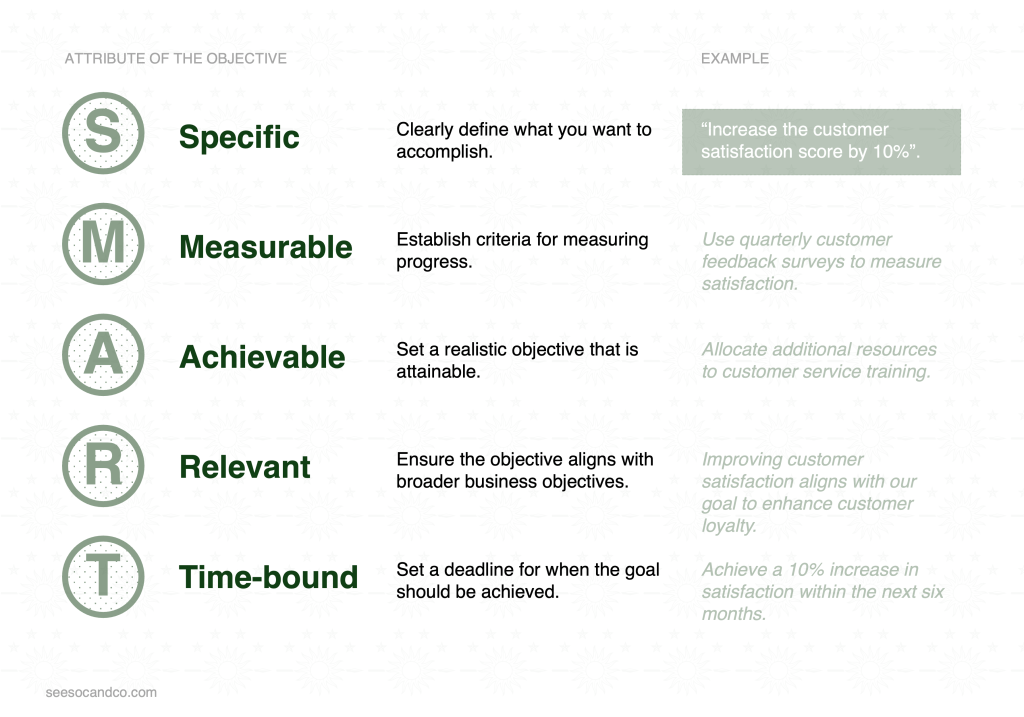
People often lack clarity on what actions to take and whether they are progressing in the right direction and at the right pace.
SMART objectives provide clear direction and align efforts, making it easier to achieve broader goals.
They facilitate progress tracking and boost motivation with realistic targets.
SMART objectives also ensure relevance to business goals and create urgency with deadlines.
What to do
Formulate your objective in a sentence (Specific) and review the SMART attributes to iteratively refine it.
Include quantifiable criteria (Measurable) to track progress; e.g., related to money, time, number of events. Introduce consistent measuring method and assumptions.
Consider material and human resources needed and constraints to verify Achievability.
Write a break down of objectives from high-level (strategic) to low-level (tactical). It also helps you verify the Relevance of objectives between each others.
Download the seesnote
Notes
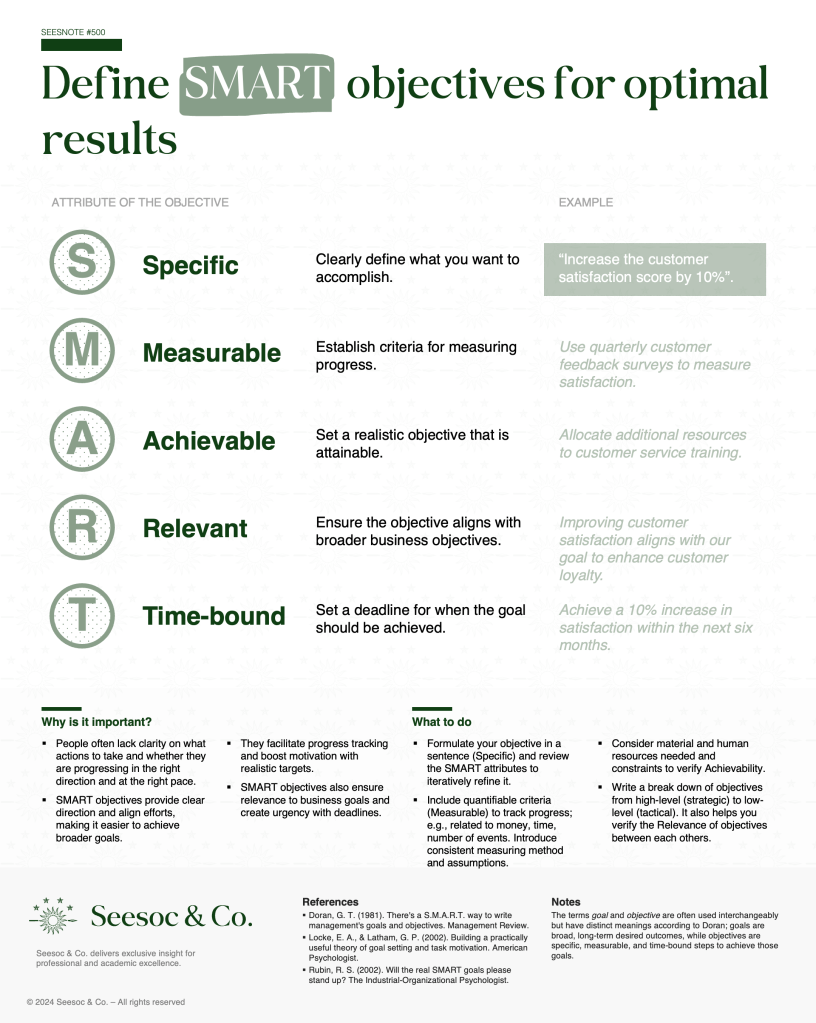
The terms goal and objective are often used interchangeably but have distinct meanings according to Doran; goals are broad, long-term desired outcomes, while objectives are specific, measurable, and time-bound steps to achieve those goals.
References
- Doran, G. T. (1981). There’s a S.M.A.R.T. way to write management’s goals and objectives. Management Review.
- Locke, E. A., & Latham, G. P. (2002). Building a practically useful theory of goal setting and task motivation. American Psychologist.
- Rubin, R. S. (2002). Will the real SMART goals please stand up? The Industrial-Organizational Psychologist.
 Seesoc & Co.